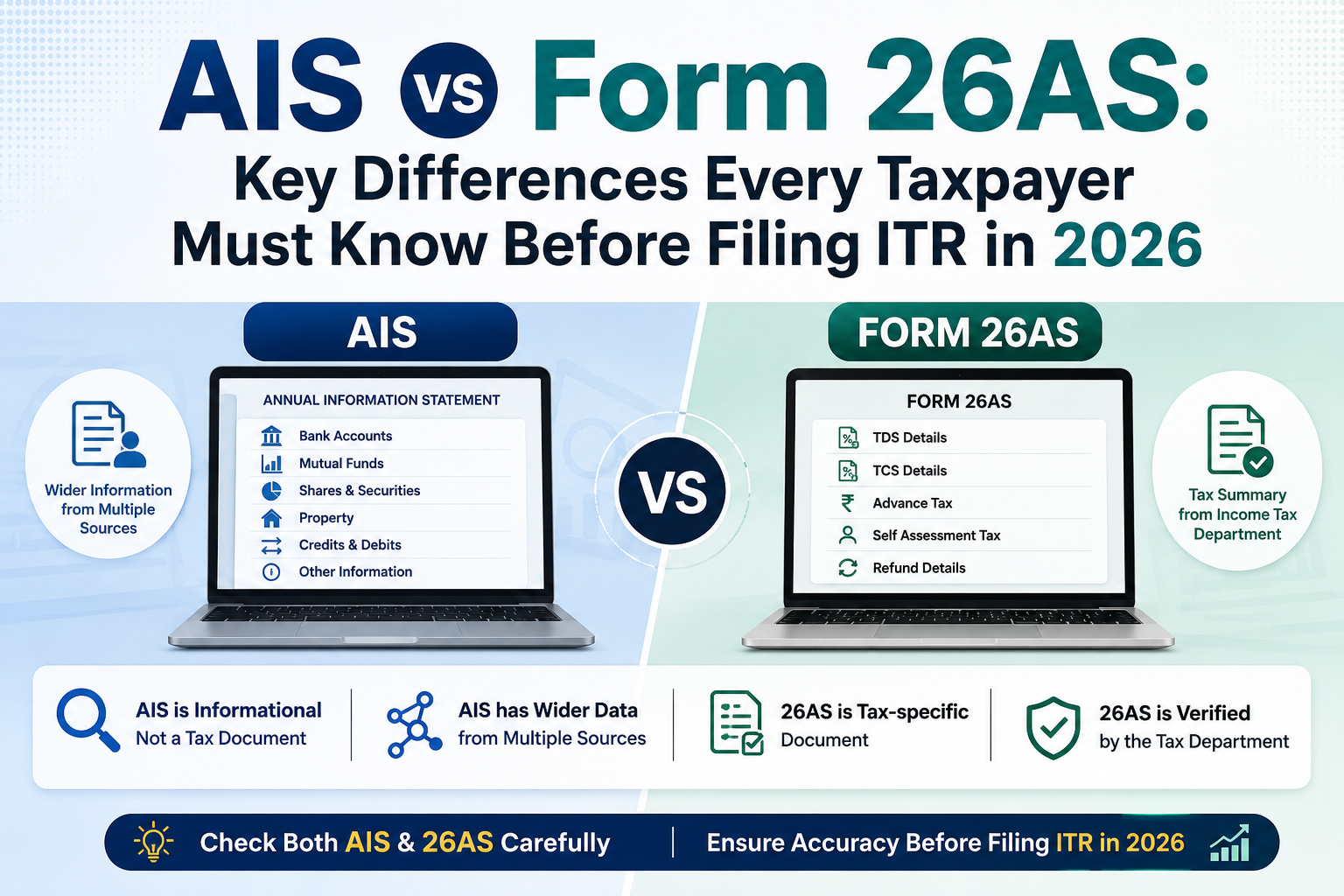
AIS vs Form 26AS: Key Differences Every Taxpayer Must Know Before Filing ITR in 2026
Introduction
As the Income Tax Return (ITR) filing season for AY 2026-27 approaches, taxpayers must ensure that all their income and tax details are correctly reported. Two important documents that help in accurate tax filing are AIS (Annual Information Statement) and Form 26AS.
Many taxpayers assume that both are the same, but they serve different purposes. Understanding the difference between AIS and Form 26AS can help you avoid tax notices, claim the correct tax credits, and file your ITR accurately.
What is AIS (Annual Information Statement)?
AIS is a comprehensive statement introduced by the Income Tax Department that provides detailed information about your financial transactions during a financial year.
AIS includes:
- Salary Income
- Interest from Savings Accounts and Fixed Deposits
- Dividend Income
- Mutual Fund Transactions
- Stock Market Transactions
- Property Purchase and Sale Transactions
- Foreign Remittances
- TDS and TCS Information
- GST Related Information
- High-Value Financial Transactions
The purpose of AIS is to give taxpayers a complete view of information reported to the Income Tax Department.
What is Form 26AS?
Form 26AS is a consolidated tax statement that shows taxes deducted or collected against your PAN.
It contains:
- TDS Details
- TCS Details
- Advance Tax Payments
- Self-Assessment Tax Payments
- Income Tax Refund Details
- Specified Financial Transactions
Form 26AS acts as a tax credit statement and helps taxpayers verify whether taxes have been correctly deposited.
AIS vs Form 26AS: Major Differences
| Particulars | AIS | Form 26AS |
|---|---|---|
| Purpose | Detailed financial information | Tax credit statement |
| Salary Details | Yes | Limited |
| Interest Income | Yes | Limited |
| Dividend Income | Yes | Limited |
| Mutual Fund Transactions | Yes | No |
| Stock Transactions | Yes | No |
| Property Transactions | Yes | Limited |
| TDS Details | Yes | Yes |
| Tax Payments | Yes | Yes |
| Feedback Option | Yes | No |
| Data Coverage | Comprehensive | Limited |
Why Should You Check AIS Before Filing ITR?
Many taxpayers rely only on Form 26AS and overlook important income information available in AIS.
Checking AIS helps:
- Avoid income mismatches
- Report all income correctly
- Reduce the risk of receiving tax notices
- Prevent penalties and interest
- Ensure faster processing of tax refunds
How to Download AIS Online?
Follow these simple steps:
Step 1:
Visit the Income Tax e-Filing Portal.
Step 2:
Login using your PAN and password.
Step 3:
Go to:
Services → Annual Information Statement (AIS)
Step 4:
Click on AIS.
Step 5:
Download the AIS report in PDF format.
How to Download Form 26AS?
Step 1:
Login to the Income Tax Portal.
Step 2:
Navigate to:
e-File → Income Tax Returns → View Form 26AS
Step 3:
Accept the disclaimer and proceed to TRACES.
Step 4:
Download Form 26AS.
Common Mistakes Taxpayers Make
1. Ignoring Interest Income
Interest earned from savings accounts and fixed deposits often appears in AIS.
2. Not Reporting Dividend Income
Dividend income reflected in AIS should be reported while filing ITR.
3. Missing Capital Gains
Stock market and mutual fund transactions must be declared accurately.
4. Filing ITR Without Verification
Always compare AIS, Form 26AS, Form 16, and bank statements.
5. Assuming Form 26AS Contains All Information
Form 26AS is not as comprehensive as AIS.
What If AIS and Form 26AS Show Different Information?
Differences may occur because of:
- Reporting delays by institutions
- Incorrect PAN reporting
- Updated financial transaction records
- Data synchronization issues
Before filing your ITR, verify all information and rectify discrepancies if required.
Benefits of Reviewing AIS and Form 26AS
✔ Accurate Income Tax Return Filing
✔ Better Tax Compliance
✔ Reduced Chances of Tax Notices
✔ Faster Tax Refund Processing
✔ Complete Income Reporting
✔ Peace of Mind During Tax Filing
Who Should Review AIS?
AIS should be checked by:
- Salaried Employees
- Freelancers
- Business Owners
- Professionals
- Investors
- NRIs
- GST Registered Taxpayers
Expert Advice
Before filing your ITR for AY 2026-27, compare the following documents:
- AIS
- Form 26AS
- Form 16
- Bank Statements
- Investment Proofs
- Capital Gain Statements
This simple step can save you from future tax disputes and notices.
Frequently Asked Questions (FAQs)
What is AIS in Income Tax?
AIS (Annual Information Statement) is a detailed statement that contains information about your income, investments, tax deductions, and financial transactions.
What is Form 26AS?
Form 26AS is a tax credit statement that shows TDS, TCS, tax payments, and refunds associated with your PAN.
Is AIS mandatory for filing ITR?
No, but reviewing AIS before filing ITR is highly recommended to avoid errors.
Which is more important: AIS or Form 26AS?
Both are important. AIS provides comprehensive financial information, while Form 26AS verifies tax credits and payments.
Can I file ITR using only Form 26AS?
It is not advisable. Taxpayers should review both AIS and Form 26AS before filing their returns.
How can I check AIS online?
You can access AIS through the Income Tax e-Filing Portal under the Services section after logging in.
Conclusion
AIS and Form 26AS are essential tools for every taxpayer. While Form 26AS helps verify tax credits and deductions, AIS provides a complete overview of your financial activities. Reviewing both documents before filing your Income Tax Return can help you avoid errors, reduce the chances of receiving notices, and ensure smooth tax compliance.
If you need expert assistance with Income Tax Return Filing, Tax Notices, GST Registration, GST Return Filing, or Tax Compliance Services, contact The Online Tax for professional guidance.