CORPORATE LICENSES & IP
FSSAI License: Sell Food Legally
If your business touches food—whether you are manufacturing snacks, operating a cloud kitchen, importing packaged goods, or running a local grocery store—you must be registered with the Food Safety and Standards Authority of India (FSSAI). Operating without this 14-digit FoSCoS license is a criminal offense that can lead to immediate business closure and penalties up to ₹5 Lakhs.
At The Online Tax, we navigate the complex FoSCoS portal for you. Whether you are a home baker needing a Basic Registration or a massive manufacturer requiring a Central License, our compliance experts classify your business accurately, draft your Food Safety Management System (FSMS) plans, and secure your license fast so you can confidently list on Swiggy, Zomato, or retail shelves.

THE 3 LICENSE TIERS
Which FSSAI Category Fits You?
Effective April 2026, the government significantly increased the turnover limits to reduce the compliance burden on small and medium food businesses.
Basic Registration
For petty food retailers, street vendors, home bakers, and small-scale operations.
- Turnover: Up to ₹1.5 Crore annually.
- Capacity: Production capacity of up to 100 kg/liters per day.
- Application: Form A is filed with the local municipal authority.
State License
For mid-sized food manufacturers, restaurants, cloud kitchens, and intra-state distributors.
- Turnover: Between ₹1.5 Crore and ₹50 Crore annually.
- Capacity: Production between 100 kg and 2 MT per day.
- Application: Form B is filed with the State Government.
Central License
For massive food corporations, nationwide e-commerce platforms, and all food importers.
- Turnover: Above ₹50 Crore annually.
- Mandatory For: E-commerce (Zomato/Swiggy operators), Importers, and multi-state chains regardless of turnover.
- Application: Form B filed directly with the Central Government.
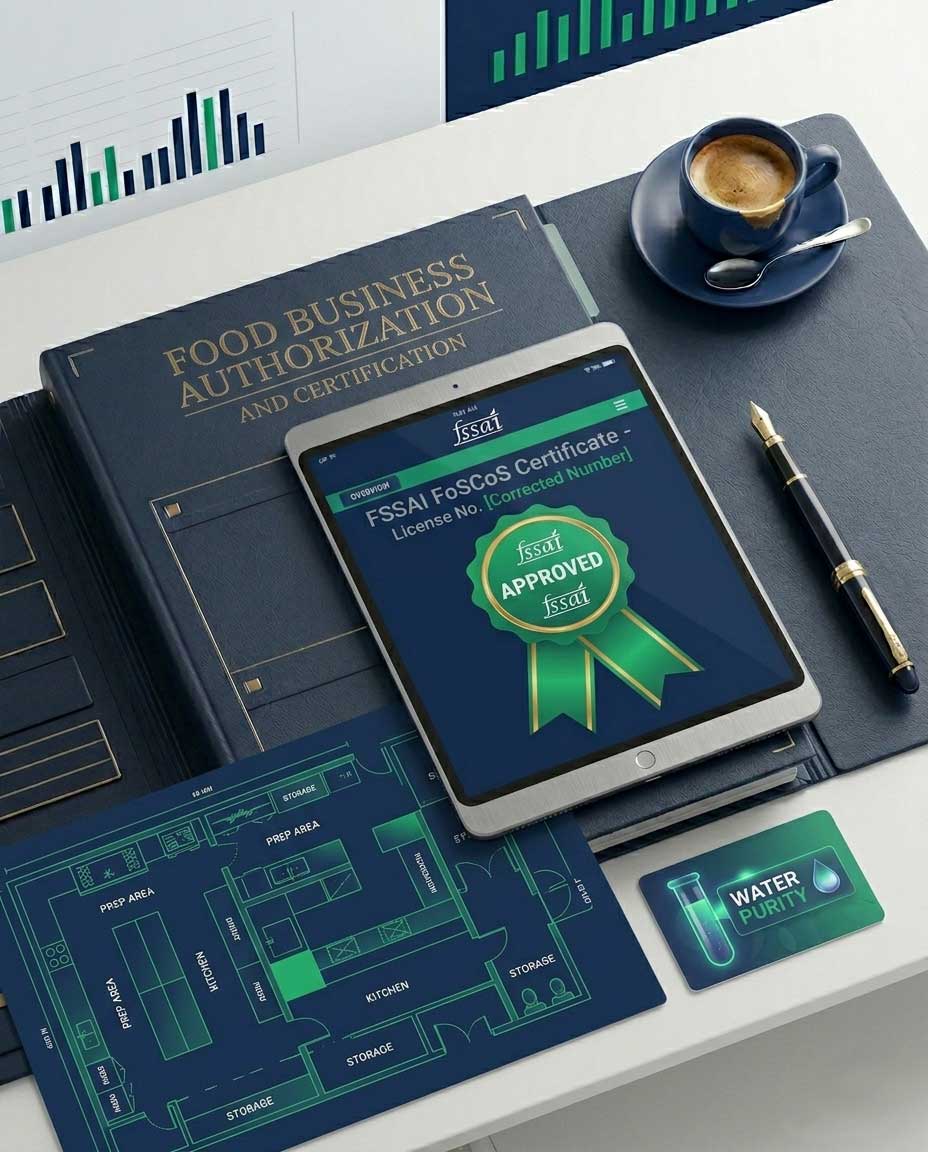
DOCUMENTATION
Strict Health & Safety Proofs
Basic registration requires simple KYC. However, if you are applying for a State or Central License, the FSSAI mandates rigorous proofs regarding your premise layout and water quality.
Owner Identity
Passport-size photograph, PAN card, and Aadhaar card of the Proprietor, Partners, or Directors.
Premise Proof & Layout
Rent agreement and NOC from the owner. For State/Central licenses, a blueprint or layout plan of the processing unit is mandatory.
Water Test Report
For manufacturing units, an official water testing report from an FSSAI-recognized laboratory confirming the water is safe as an ingredient.
FSMS Declaration
A formal Food Safety Management System (FSMS) plan or self-declaration affirming your commitment to hygiene standards.
CLARIFICATIONS
Frequently Asked Questions
Critical regulatory answers for Food Business Operators (FBOs).